
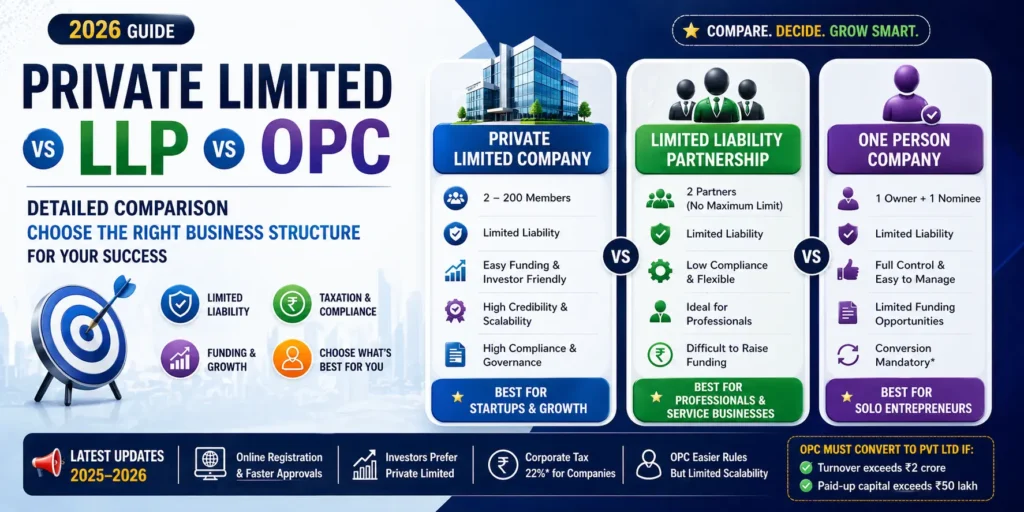
Choosing the right business structure in India is one of the most important decisions an entrepreneur can make. Whether you are starting a startup, a small business, or a solo venture, your choice between a Private Limited Company, an LLP, and an OPC will directly impact taxation, compliance, funding, scalability, and legal protection. Understanding the importance of company compliance services is equally crucial, as each structure comes with its own legal requirements and regulatory obligations.
This guide covers everything—from definitions to the latest updates (2025–2026), advantages and disadvantages, taxation, compliance, and how professional company compliance services can help you stay compliant and grow your business smoothly.
What is a Private Limited Company?
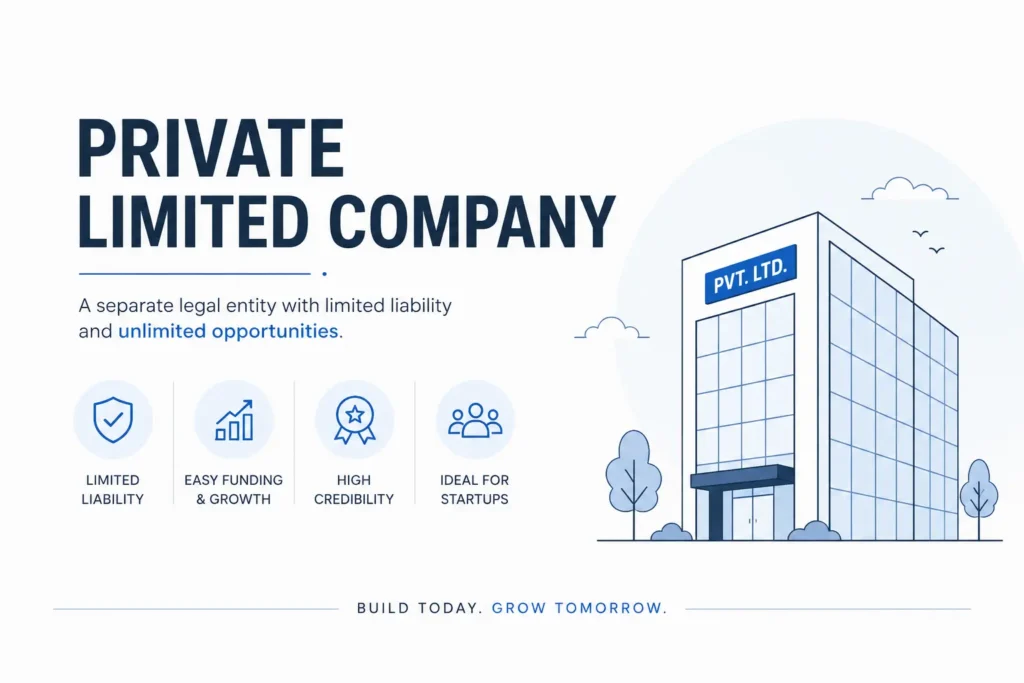
A Private Limited Company (Pvt Ltd) is a business entity registered under the Companies Act, 2013. It has a separate legal identity, meaning the company exists independently of its owners.
Key Features
• Minimum 2 shareholders and 2 directors
• Limited liability protection
• Can raise funds via equity shares
• High credibility in the market
• Suitable for scalable businesses
Advantages
• Easy funding from investors and VCs
• High brand credibility
• Ownership transfer through shares
• Ideal for startups and expansion
Disadvantages
• High compliance (ROC filings, audits)
• Higher setup and maintenance costs
• Mandatory board meetings and governance
Next, let’s understand the LLP structure and how it compares to other structures.
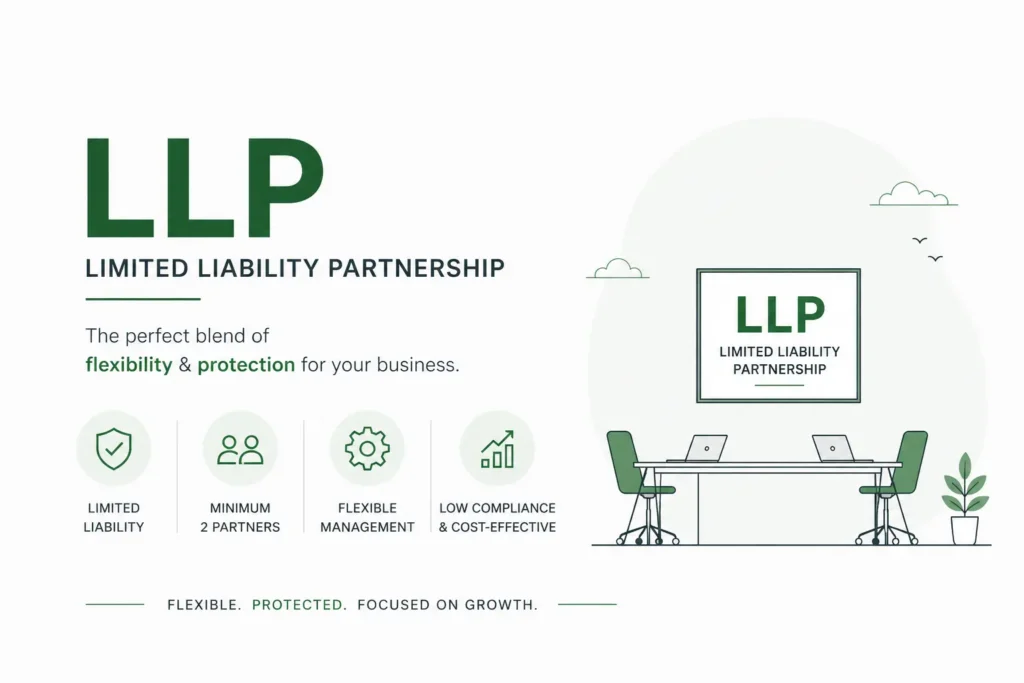
An LLP (Limited Liability Partnership) combines features of a partnership and a company. It offers flexibility with limited liability protection.
Key Features
• Minimum 2 partners required
• No maximum limit on partners• Separate legal entity
• Flexible profit sharing
Advantages
• Lower compliance than Pvt Ltd
• Cost-effective setup
• No mandatory board meetings
• Suitable for professionals
Disadvantages
• Difficult to raise funding
• Cannot issue shares
• Lower investor interest
Now, let’s look at OPC, which provides another option for entrepreneurs.
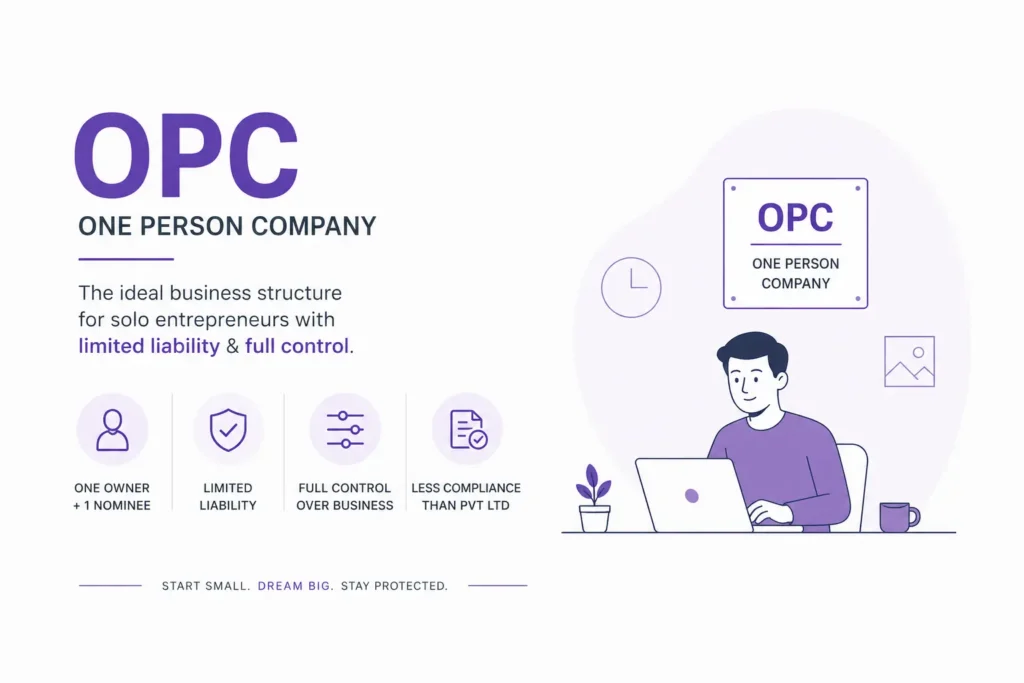
An OPC (One Person Company) is designed for solo entrepreneurs who want a company structure with limited liability.
Key Features
• Only 1 owner + 1 nominee
• Separate legal identity
• Limited liability protection
Advantages
• Ideal for solo founders
• Full control over business
• Less compliance than Pvt Ltd
Disadvantages
• Limited funding opportunities
• Growth restrictions
• Mandatory conversion after threshold
Latest Rule (Important Update)
OPC must convert to Pvt Ltd if :
- Turnover exceeds ₹2 crore
- Paid-up capital exceeds ₹50 lakh
Private Limited vs LLP vs OPC – Comparison Table (2026)
Feature Private Limited LLP OPC Minimum Members 2 2 1 Maximum Members 200 No limit 1 Legal Identity Separate Separate Separate Liability Limited Limited Limited Compliance High Moderate Moderate Funding Easy Difficult Very Limited Taxation 22–25% approx. 30% approx. Same as Pvt Ltd Audit Mandatory Conditional Mandatory Best For Startups Professionals Solo founders
(Source: compiled from latest industry comparisons )
Taxation Comparison (Latest 2026)
Private Limited Company
- Tax rate: 22%–25% (approx.)
- Eligible for startup tax benefits
LLP
- Flat tax rate: 30%
OPC
- Taxed like Pvt Ltd
Conclusion: Pvt Ltd offers better tax optimization options.
Compliance Comparison
| Compliance | Pvt Ltd | LLP | OPC |
| Annual Filing | Mandatory | Mandatory | Mandatory |
| Audit | Mandatory | Conditional | Mandatory |
| Board Meetings | Required | Not Required | Limited |
| ROC Filing | Frequent | Moderate | Moderate |
LLP has the lowest compliance burden.
Funding & Investment Comparison
Private Limited
- Best for funding
- Preferred by investors
- Can issue shares
LLP
- No equity shares
- Limited funding options
OPC
- Not investor-friendly
Winner: Private Limited Company
Latest Updates (2025–2026)
1. Ease of Doing Business Improvements
- Online registration via the MCA portal
- Faster approvals for company incorporation
2. Startup Ecosystem Growth
- Investors strongly prefer the Pvt Ltd structure
- LLPs are mostly used for service businesses
3. OPC Relaxation
- No minimum capital requirement
- Easier conversion rules
- Still limited scalability
4. Tax Regime Updates
- Corporate tax reduced to 22% for companies
- LLP still taxed at 30% flat rate
Which is Best for You? (Decision Guide)
Choose a Private Limited Company if
- You want funding
- Planning to scale the business
- Need high credibility
Choose LLP if
- You run a small or service business
- Want low compliance
- Have 2+ partners
Choose OPC if
- You are a solo entrepreneur
- Starting small
- Don’t need funding immediately
Real-Life Use Cases
Startup Founder
Go for Pvt Ltd (best for funding and growth)
CA / Lawyer / Consultant
LLP is ideal
Freelancer / Solo Business
OPC is best
Advantages Summary
| Private Limited | LLP | OPC |
| Best for growth & funding | Low cost & flexible | Perfect for solo founders |
| High credibility | Minimal compliance | Easy to manage |
Disadvantages Summary
| Private Limited | LLP | OPC |
| Expensive | Limited scalability | Growth restrictions |
| Expensive | Not investor-friendly | Conversion mandatory |
FREQUENTLY ASKED QUESTION
Which is better, LLP or Pvt Ltd?
Pvt Ltd is better for growth, LLP for small business.
Can OPC be converted into a Pvt Ltd company?
Yes, after crossing turnover/capital limits.
Which structure has the lowest compliance?
LLP
Which is best for startups?
Private Limited Company
Final Conclusion
There is no one-size-fits-all answer. Your choice should depend on:
• Business size
• Funding needs
• Growth plans
• Compliance capacity
In simple terms:
• Startup = Pvt Ltd
• Small business = LLP
• Solo entrepreneur = OPC