

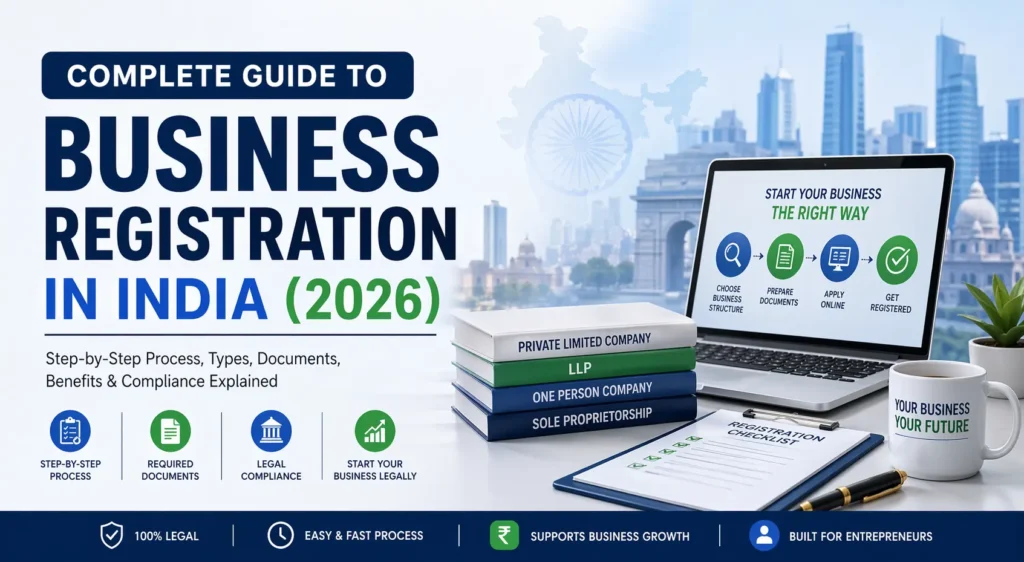
Starting a business in India is now easier due to digital processes and government support. Whether launching a startup or local service, it’s essential to understand the registration process for legal compliance and growth.
This guide explains how to register a company in India, covering steps, costs, documents, and business structures.
Introduction to Business Registration in India
Business registration is the legal process of forming a company or entity recognized by the government. It allows you to operate legally, open a business bank account, and access funding opportunities.
In 2026, most registrations are done online through the Ministry of Corporate Affairs (MCA) portal, making the process faster and more transparent.
Types of Business Structures in India
Choosing the right structure is the most important step. Consider factors such as funding needs, liability protection, future growth plans, and the number of founders involved. For example, Private Limited Companies are better for those seeking external funding and scalability, while a Sole Proprietorship is better for those seeking full control and simpler compliance.
Sole Proprietorship (non-legal entity)
Best for small businesses
Easy to start
Minimal compliance

Partnership Firm (non-legal entity)
Two or more owners
Shared profits and responsibilities
Requires a partnership deed

Limited Liability Partnership (LLP)

Private Limited Company
Most popular for startups
Separate legal identity
Easy funding & scalability

One Person Company (OPC)
Ideal for solo entrepreneurs
Limited liability with a single owner

Step-by-Step Process to Register a Business in India
Here’s the exact process for company registration in India (2026):
Step 1: Choose Business Structure
Choose a proprietorship, LLP, or private limited company.
Step 2: Apply for DSC & DIN
- DSC (Digital Signature Certificate)
- DIN (Director Identification Number)
Step 3: Name Approval
Submit your business name through the MCA portal for approval.
Step 4: Company Incorporation
File SPICe (part A ) Name Approval and File Spice (Part B) final form + forms with required documents.
Step 5: PAN, TAN & Bank Account
After approval:
- Get PAN & TAN
- Open a business bank account.
Documents Required for Business Registration
Two sets of documents required :
1st set ( All Directors)
- PAN Card of the owner/directors
- Aadhaar Card / ID proof
- Address proof (e.g., electricity bill)
- Passport-size photos
2nd set for Office Registration
- Latest Electricity Bill / Gas Bill or Landline Bill // Mobile Bill
- No Objection Certificate from the owner of the Premises
Cost of Business Registration in India (2026)
The cost depends on the business type:
- Sole Proprietorship: ₹1,000 – ₹5,000
- LLP Registration: ₹5,000 – ₹15,000
- Private Limited Company: ₹7,000 – ₹25,000
Costs may vary based on professional fees and the state. Some states, like Maharashtra, Karnataka, and Tamil Nadu, are typically more expensive due to higher stamp duties or additional local requirements. Additionally, certain states may require additional documentation or have unique compliance requirements. Make sure to check the state-specific rules before proceeding.
GST & MSME Registration Explained
GST Registration
Required if:
- Turnover exceeds ₹20 lakh (₹10 lakh for some states)
- Selling online or interstate
MSME Registration
- Free registration
- Access to government benefits
- Easier loan approvals
Benefits of Registering Your Business
- Legal recognition
- Limited liability protection
- Easy access to funding
- Brand credibility
- Tax benefits
Common Mistakes to Avoid
- Choosing the wrong business structure
- Incorrect documentation
- Ignoring compliance requirements
- After registration, make sure to keep up with ongoing compliance tasks, including annual filings with the MCA, maintaining statutory registers, filing GST returns, renewing licenses, and paying applicable taxes. These steps are crucial for avoiding penalties and ensuring your business remains in good standing.
- Delaying GST registration
- Not consulting a professional. To find reliable experts, ask trusted business owners for referrals, search for consultants on reputable online platforms, or check professional directories. Look for credentials, client reviews, and proven experience to ensure you get trustworthy support.
FAQs on Business Registration in India
1-How long does it take to register a company in India?
Usually 7–15 working days.
2-Can I register a business online in India?
Yes, the entire process is online via MCA.
3-Do I need to register for GST if I run a small business?
Only if turnover exceeds the threshold or you sell online.
4-What is the cheapest way to start a business?
A sole proprietorship is the most affordable option.
CONCLUSION
Registering your business in India is a crucial step toward building a successful and legally compliant venture. By choosing the right structure and following the correct process, you can start your journey smoothly in 2026.
After registration, take immediate steps to move forward confidently: open your business bank account, apply for necessary licenses and permits depending on your industry, and set up your accounting system. Make sure to register for GST or MSME if eligible, and keep all documents organised for future compliance needs.
Ready to register your business? Take the first step now for expert support and a seamless experience.
Contact us today for personalised assistance with registering your company quickly and hassle-free.
call 092114 47604 https://accountswaale.com/