

Starting a business in India is exciting, but legal registration is a crucial first step. Though the process has been streamlined, many first-time entrepreneurs are surprised by the cost of registering a company in India and the various fees involved.
There is no fixed fee for company registration in India. The cost of registering a company depends on your business structure, state, authorized capital, and whether you use professional help. This guide breaks down every expense so you can budget confidently.
How Much Does It Cost to Register a Company in India?
The cost of registering a company in India varies widely depending on the chosen business structure. To get started, here’s a quick snapshot:
| Business Type | Approximate Total Cost (2025–26) |
|---|---|
| Sole Proprietorship | ₹1,500 – ₹10,000 |
| Private Limited Company | ₹8,000 – ₹17,000 |
| LLP | ₹5,000 – ₹10,000 |
| One Person Company (OPC) | ₹8,000 – ₹17,000 |
These ranges include government fees, stamp duty, Digital Signature Certificates (DSC), and professional charges. Next, let’s look more closely at what each component entails.
Pvt Ltd Company Registration on MCA — What You Need to Know
The Private Limited Company is the most popular structure for startups and growing businesses in India. It’s regulated by the Ministry of Corporate Affairs (MCA) under the Companies Act, 2013, and the entire registration process is handled digitally through the SPICe+ (Simplified Proforma for Incorporating Company Electronically Plus) integrated form on the MCA21 portal.
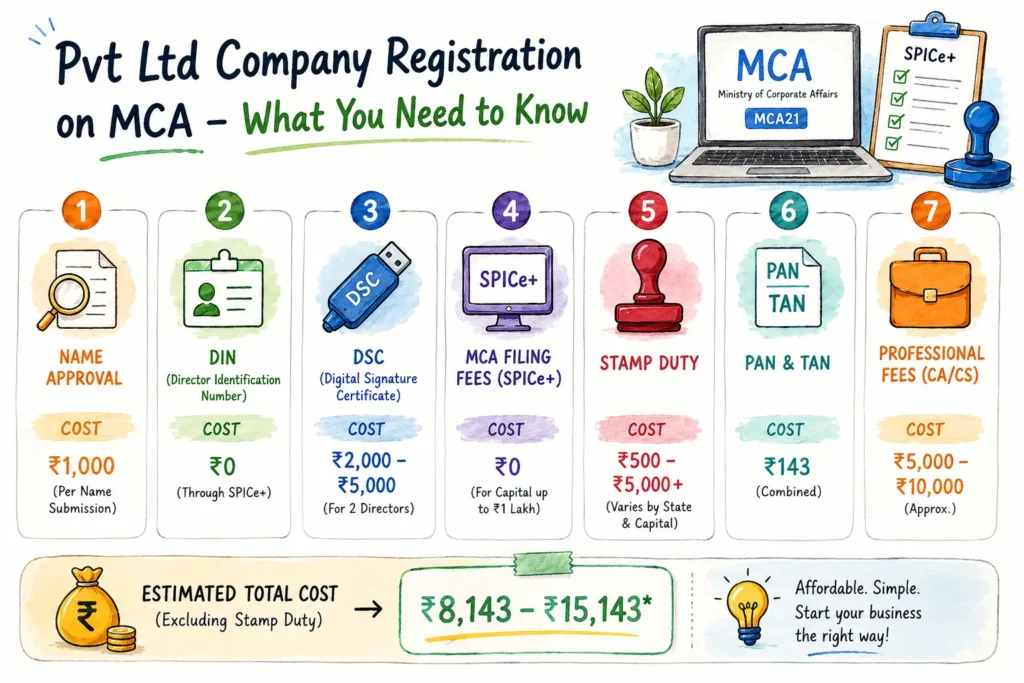
Here’s what the MCA registration process involves and what each step :
Director Identification Number (DIN): Every director needs a unique DIN. If applied through the SPICe+ form at the time of incorporation, there is no separate government fee.
Digital Signature Certificate (DSC): Each director must have a DSC to sign documents electronically. A Class 3 DSC costs between ₹1,000 and ₹2,500 per person, depending on the certifying authority (like e-Mudhra, Sify, or NSDL eSign) and validity period. For a company with two directors, the combined budget is ₹2,000-₹5,000.
Name Approval: Before incorporation, you must reserve your company’s name with the ROC through the SPICe+ Part A form. This costs ₹1,000 per name submission.
MCA Filing Fees (SPICe+ Form): This is where India’s startup-friendly policies shine. For capital up to ₹1 lakh, the SPICe+ registration fee is essentially ₹0 — a significant incentive for small businesses and new founders.
Stamp Duty: This fee varies the most and is often the biggest expense. States levy stamp duty on the Memorandum of Association (MoA) and Articles of Association (AoA), and rates differ greatly. Punjab, Gujarat, and Kerala typically impose higher stamp duties, while Delhi, Karnataka, and Tamil Nadu levy lower charges. On average, stamp duty ranges from ₹500 to ₹5,000 or more, based on your state and authorized capital.
PAN and TAN: Applying for PAN and TAN through the SPICe+ form costs approximately ₹143 combined — a small but mandatory expense.
Professional Fees (CA/CS): If you hire a Chartered Accountant or Company Secretary to handle the process, expect to pay ₹5,000 to ₹10,000, depending on the complexity of your structure, the number of directors, and the scope of services.
Cost of Registering a Private Limited Company in India
Putting it all together, the total cost to register a Private Limited Company in India in 2025–26 for a standard startup with ₹1 lakh authorized capital typically falls between ₹8,000 to ₹17,000 .
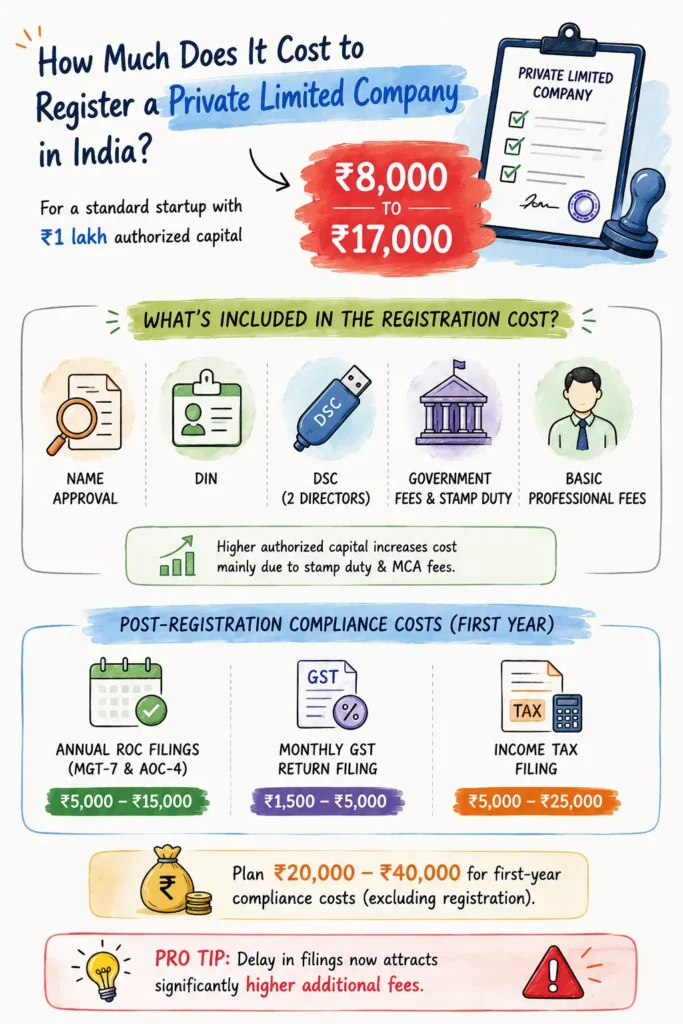
This total includes government fees, stamp duty, DSC for two directors, name approval, and basic professional fees. If your company has higher authorized capital, the cost will rise—primarily due to increases in stamp duty and MCA filing fees.
Post-registration compliance costs should also be anticipated early. For example, annual ROC filings (MGT-7 and AOC-4) incur professional fees of ₹5,000 to ₹15,000. Monthly GST return filing ranges from ₹1,500 to ₹5,000 in CA fees. Income tax filing generally costs ₹5,000 to ₹25,000 per year. Consequently, a prudent founder should allocate ₹20,000 to ₹40,000 for first-year compliance costs, excluding the one-time registration expense.
Pro tip: The MCA has tightened rules around delayed filings. Late submission of statutory forms, such as annual returns and financial statements, now attracts significantly higher additional fees. Staying on top of filing deadlines isn’t just good practice — it’s financially smart.
LLP Company Registration Fees & Cost in India
. A Limited Liability Partnership (LLP) is a flexible, cost-effective business structure that combines the benefits of a partnership with the limited liability protection of a company. It’s especially popular among professionals, consultants, and small service businesses
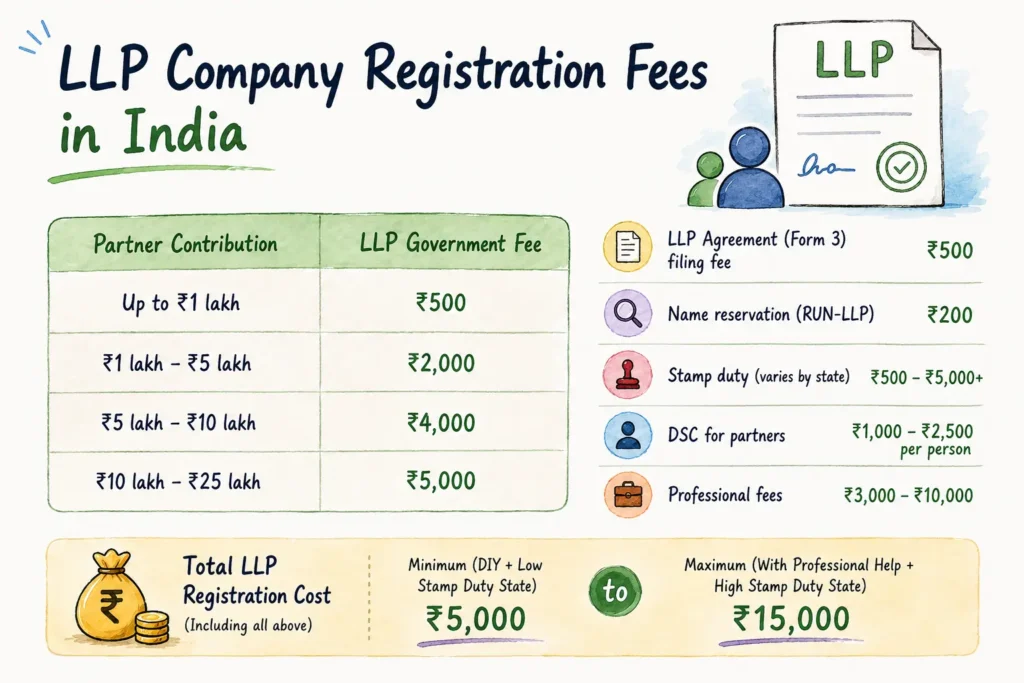
LLP registration fees are based on the total partner contribution (equivalent to authorized capital in companies):
| Partner Contribution | LLP Government Fee |
|---|---|
| Up to ₹1 lakh | ₹500 |
| ₹1 lakh – ₹5 lakh | ₹2000 |
| ₹5 lakh – ₹10 lakh | ₹4000 |
| ₹10 lakh – ₹25 lakh | ₹5000 |
Additionally, the LLP Agreement (Form 3) filing fee is ₹500. Name reservation through the RUN-LLP form attracts a small government fee of ₹200. Stamp duty on the LLP Agreement varies by state and can range from ₹500 to ₹5,000+.
With DSC costs for partners (₹1,000–₹2,500 per person) and professional fees (₹3,000–₹10,000), the total LLP registration cost typically falls between ₹5,000 (if you handle most filings yourself in a low stamp duty state) and ₹15,000 (if you use professional help and stamp duty is higher), making it one of the most affordable formal business structures in India.
Proprietor Company Registration — The Cheapest Cost of Registering a Company in India
A Sole Proprietorship is the quickest and most economical way to launch a business in India. It’s perfect for freelancers, traders, home-based businesses, and small service providers who want to get started quickly, without heavy regulatory burdens.
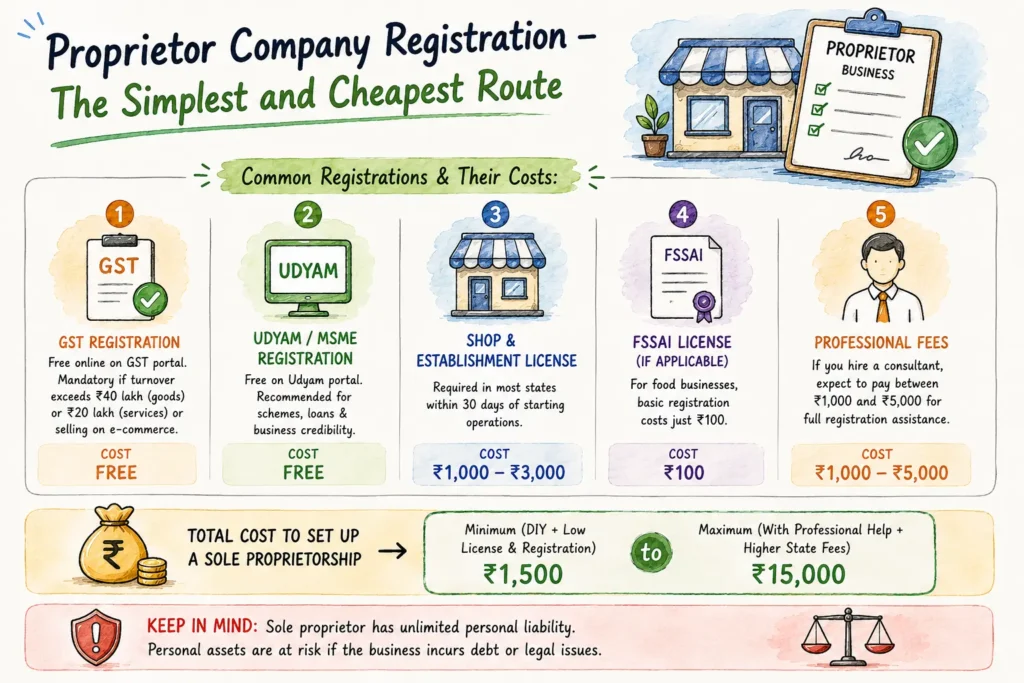
The key distinction is that there’s no single central government registration to create a proprietorship. Unlike a Pvt Ltd or LLP, there’s no formal incorporation process. Instead, the costs stem from specific licenses and registrations required to give your business legal recognition and enable you to open a current bank account.
Common Sole Proprietorship Registrations and Their Costs
- GST Registration: Free when done online through the GST portal. Mandatory if annual turnover exceeds ₹40 lakh (goods) or ₹20 lakh (services), or if you sell through e-commerce platforms.
- Udyam/MSME Registration: Completely free on the Udyam portal — and highly recommended for accessing government schemes, easier loans, and business credibility.
- Shop & Establishment License: Required in most states within 30 days of starting operations. Costs approximately ₹1,000 to ₹3,000 depending on the state.
- FSSAI License (if applicable): For food businesses, basic registration costs just ₹100.
- Professional Fees: If you hire a consultant, expect to pay between ₹1,000 and ₹5,000 for full registration assistance.
In total, a sole proprietorship can be set up for as little as ₹1,500 (in a state with lower license and registration costs, doing filings yourself) to as much as ₹15,000 (with professional help and in states with higher fees), making it the most budget-friendly way to enter formal business. However, keep in mind the trade-off: a sole proprietor has unlimited personal liability, meaning personal assets are at risk if the business incurs debt or legal issues.
Hidden & Additional Costs of Registering a Company in India
In addition to the obvious registration fees, several less-visible expenses can come as a surprise to new entrepreneurs:
Trademark Registration: If you want to protect your brand name or logo, it costs ₹4,500 to ₹9,000 per class of goods/services.
Registered Office Rental: If you don’t have a permanent office address, a virtual office service (often acceptable for MCA registration) can cost as little as ₹1,000 per month for basic virtual services to as much as ₹5,000 per month for premium options.
Company Seal and Stationery: Printing, notarisation, and other administrative costs can add around ₹1,000 to ₹2,000.
Sector-Specific Licenses: Businesses in food, healthcare, finance, or import/export will need additional licenses (FSSAI, RBI approvals, IEC code for imports/exports), each carrying its own fees and timelines.
Key Factors That Affect the Cost of Registering a Company in India
Understanding what drives registration costs will help you plan more effectively. The main variables include:
Business Structure: Pvt Ltds require stricter compliance and more paperwork than LLPs or proprietorships, creating higher upfront costs. Choose a structure that matches your current scale, not a distant vision.
Authorized Capital: MCA filing fees and stamp duty both scale with your declared authorized capital. Starting at ₹1 lakh minimizes costs — you can always increase it later.
State of Registration: Stamp duty is state-levied and creates the biggest geographic price difference. The same company registered in Maharashtra or Punjab will cost more than in Delhi or Karnataka.
Number of Directors/Partners: Each director or partner needs a DSC and, potentially, a DIN, so more people mean higher upfront costs.
DIY vs. Professional Help: Handling the MCA portal yourself saves on costs, but mistakes can lead to rejections and add refiling expenses. Most first-timers discover that professional fees can offset wasted time and errors. Note: The forms have to be certified by a professional – CA/ CS/ CMA etc.
Tips to Reduce the Cost of Registering a Company in India
- Start with a lower authorized capital. Since MCA fees and stamp duty scale with authorized capital, starting at ₹1 lakh, keep your initial registration cost minimal.
- Bundle your services. Many online legal platforms offer package deals that combine DIN, DSC, name approval, and SPICe+ filing at a discounted rate.
- Register in a lower-stamp-duty state if your business allows flexibility in registered office location.
- File on time — always. Delayed statutory filings attract heavy additional penalties that can dwarf the original fee.
- Compare professionals. CA and CS fees vary significantly; get 2–3 quotes before committing.
Final Thoughts
Registering a company in India is far more affordable today than it was a decade ago, thanks to digital reforms and MCA’s startup-friendly policies. Whether you’re a solo entrepreneur opting for a proprietorship, a pair of co-founders building a Pvt Ltd, or professionals forming an LLP, there’s a cost-effective path for every aspiration.
The key is to understand what you’re paying for, plan ahead for compliance costs, and work with reliable professionals who won’t surprise you with hidden charges. With the right information and a smart approach, your business can be legally registered and ready to operate — without breaking the bank.
Need help choosing the right business structure?
AccountsWaale helps startups, freelancers, and entrepreneurs register their companies legally and affordably across India. Speak with our experts today and launch your business with confidence.
Get Transparent Pricing Now +91 9211447604