
Starting a business in India involves much more than registering a company and launching your product or service. Once a business is incorporated or registered, founders may need to meet several legal, tax, accounting, and regulatory requirements.
For a new business owner, understanding startup compliance in India during the first year can feel complicated. Requirements vary by business structure, turnover, employees, industry, location, and nature of operations.
This startup compliance checklist India guide explains the major areas that new founders should understand during their first year, including company or LLP compliance, GST, income tax, TDS, accounting records and applicable business registrations.
Important: Compliance requirements vary from one business to another. Not every startup is required to complete every compliance mentioned below. Requirements should be checked according to the entity type, business activity and applicable laws.
What Is Startup Compliance?

Startup compliance refers to the legal, tax, financial and regulatory responsibilities that a business needs to follow after starting operations.
These requirements may include:
- Maintaining proper books of accounts
- Filing applicable tax returns
- GST registration and returns, where applicable
- TDS compliance, where applicable
- MCA/ROC filings for companies and LLPs
- Maintaining statutory records
- Obtaining industry-specific licences
- Filing income tax returns
- Following applicable employment and labour requirements
The exact compliance obligations depend on how the business is structured and what it does.
For example, a Private Limited Company can have different annual filing requirements from an LLP or a partnership firm. Similarly, a food business may have additional requirements such as FSSAI registration or licensing.
Why Is First-Year Compliance Important for Startups?
The first year is an important period for establishing proper business systems.
Founders are usually focused on customers, sales, hiring and growth. Compliance can therefore become an afterthought. However, missing applicable filings or maintaining incomplete records can create unnecessary problems later.
A proper first-year compliance checklist for startups can help founders:
- Keep business records organised
- Track important filing requirements
- Avoid preventable compliance delays
- Maintain better financial records
- Prepare for future funding or expansion
- Understand tax and regulatory responsibilities
- Build a more structured business operation
Don’t treat compliance as just paperwork. It is part of building a sustainable business foundation.
First-Year Startup Compliance Checklist in India

1. Confirm Your Business Structure
Before handling ongoing compliance, founders should understand the business’s legal structure.
Common structures include:
- Private Limited Company
- Limited Liability Partnership (LLP)
- One Person Company (OPC)
- Partnership Firm
- Sole Proprietorship
The structure affects taxation, filings, ownership, liability and other legal requirements.
For example, a company incorporated under the Companies Act has MCA-related compliance obligations. An LLP has its own filing requirements, while a sole proprietorship does not have the same corporate filing framework.
Choosing the structure should therefore be based on factors such as business activity, number of owners, funding plans and long-term objectives.
2. Complete Post-Incorporation Requirements
Registration is only the beginning.
After incorporation, a company may need to complete certain post-incorporation formalities and maintain the required corporate records.
Depending on the entity, founders may need to pay attention to:
- Corporate records
- Shareholding records
- Statutory registers
- Board-related documentation
- Financial records
- Applicable MCA filings
- Registered office requirements
The Ministry of Corporate Affairs continues to update its systems and regulatory processes, so businesses should rely on current MCA requirements rather than outdated checklists.
3. Understand MCA and ROC Compliance
For companies and LLPs, ROC compliance is an important part of ongoing business administration.
ROC refers to the Registrar of Companies. Companies are generally required to maintain prescribed records and file applicable forms and returns with the MCA.
Depending on the entity and circumstances, compliance may involve:
- Annual returns
- Financial statements
- Changes in directors or partners
- Changes in registered office
- Share-related filings
- Other event-based filings
The exact forms and due dates depend on the entity and the nature of the filing.
Founders should therefore maintain a compliance calendar rather than waiting until a filing deadline approaches.
4. Check Whether GST Registration Applies
GST is another important area for new businesses.
Whether GST registration is required depends on factors such as turnover, nature of supplies, state, business activity and other applicable conditions.
Businesses should not assume that every startup automatically needs GST registration—or that registration is never required simply because the business is new.
Once GST registration applies, the business may also have ongoing GST return and record-keeping responsibilities.
What Should Startups Track for GST?
Depending on applicability, businesses should maintain:
- Sales invoices
- Purchase records
- Input tax credit records
- GST returns
- Tax payment records
- E-invoicing/e-way bill requirements, where applicable
The GST rules can change, so founders should verify the current requirements applicable to their business before filing.
5. Maintain Proper Books of Accounts
Accounting should begin from the early stage of the business rather than at the end of the financial year.
A startup should maintain organised records of:
- Sales
- Purchases
- Business expenses
- Bank transactions
- Invoices
- Receipts
- Loans
- Investments
- Employee-related payments
- Tax payments
Good bookkeeping can make tax filing, financial analysis and future compliance much easier.
It also gives founders a clearer picture of cash flow and business performance.
6. Understand Income Tax Compliance
Startups should understand their income tax obligations based on their legal structure and applicable tax rules.
For companies and LLPs, the applicable income tax return and related requirements can differ from those applicable to individuals or other entities.
The Income Tax Department provides separate guidance for different taxpayer categories, including companies, firms and individuals carrying on business or profession.
Founders should therefore avoid selecting an income tax return form simply because another business uses it.
7. Check TDS Applicability
TDS, or Tax Deducted at Source, can become relevant when a business makes certain types of payments.
Depending on the nature and amount of payments, TDS provisions may apply to areas such as:
- Salaries
- Professional fees
- Contractor payments
- Rent
- Interest
- Other specified payments
If TDS applies, businesses may need to deduct the appropriate tax, deposit it within the applicable timeline and complete the required reporting.
This is one area where maintaining proper accounting records from the beginning can make compliance much easier.
8. Keep Employee and Labour Compliance in Mind
Once a startup begins hiring employees, additional compliance considerations may arise.
Depending on the workforce, salary structure, location and business circumstances, requirements may relate to:
- Employee records
- Salary and payroll records
- Provident Fund
- ESIC
- Professional Tax
- Shops and Establishments requirements
- Applicable labour laws
Not every requirement applies to every startup. The applicability should be assessed based on the business’s location, employee strength and other relevant factors.
9. Obtain Industry-Specific Licences

A startup may require additional registrations or licences depending on its industry.
For example:
Food Business:
FSSAI registration or licence may be relevant.
Import/Export Business:
Import Export Code (IEC) and other applicable registrations may be required.
Manufacturing/Product Business:
BIS certification or other product-specific requirements may apply depending on the product.
Security Agency:
PSARA-related licensing requirements may apply.
Trademark/Brand:
Trademark registration can help businesses protect their brand identity.
This is why a startup compliance checklist should always be customised to the nature of the business.
Startup India and DPIIT Recognition
Eligible businesses may also consider DPIIT Startup Recognition under the Startup India initiative.
The current Startup India portal states that eligible startups can access benefits such as easier compliance, IPR-related support and certain tax-related benefits.
As of the latest Startup India information, the eligibility framework includes entities such as Private Limited Companies, LLPs, registered partnership firms and cooperative societies, subject to the applicable conditions. The current portal also states a turnover threshold of ₹200 crore for general startup recognition and a higher threshold for eligible DeepTech startups.
Because government schemes and eligibility conditions can change, founders should always check the latest official Startup India notification before applying.
What Documents Should a Startup Maintain?
Maintaining an organised document folder can make compliance easier.
Important records may include:
- Certificate of Incorporation
- PAN and TAN documents
- MOA and AOA, where applicable
- LLP agreement, where applicable
- GST registration certificate, if applicable
- Bank account documents
- Invoices and purchase records
- Accounting records
- Tax returns
- TDS records
- MCA filing acknowledgements
- Employee records
- Business licences
- Agreements and contracts
- Intellectual property documents
Keeping digital copies with clear naming conventions can also help when documents are required for tax filings, audits, funding or regulatory applications.
Common Compliance Mistakes New Founders Make
1. Thinking Registration Means Compliance Is Finished
Business registration is only the starting point. Ongoing requirements may continue throughout the year.
2. Waiting Until the Deadline
Trying to complete everything at the last minute can increase the chances of errors or missed filings.
3. Mixing Personal and Business Expenses
Separate business banking and proper accounting records can make financial management much easier.
4. Ignoring Industry-Specific Requirements
A startup may have additional licensing requirements based on its products or services.
5. Using Outdated Information
Tax and regulatory rules can change. Old blog posts or social media posts should not be treated as the final authority.
6. Not Maintaining a Compliance Calendar
A simple calendar can help founders track recurring and event-based compliance requirements.
How to Create a First-Year Compliance Calendar
A practical compliance calendar can include four columns:
| Compliance Area | Requirement | Due Date/Frequency | Status |
| MCA/ROC | Applicable company/LLP filing | As applicable | Pending/Done |
| GST | Applicable GST return | As applicable | Pending/Done |
| Income Tax | Applicable return | As applicable | Pending/Done |
| TDS | Deduction/payment/return | As applicable | Pending/Done |
| Accounting | Books and records | Ongoing | Updated/Pending |
| Licences | Renewal/filing | As applicable | Pending/Done |
The exact due dates should always be verified against the relevant government portal or notification before filing.
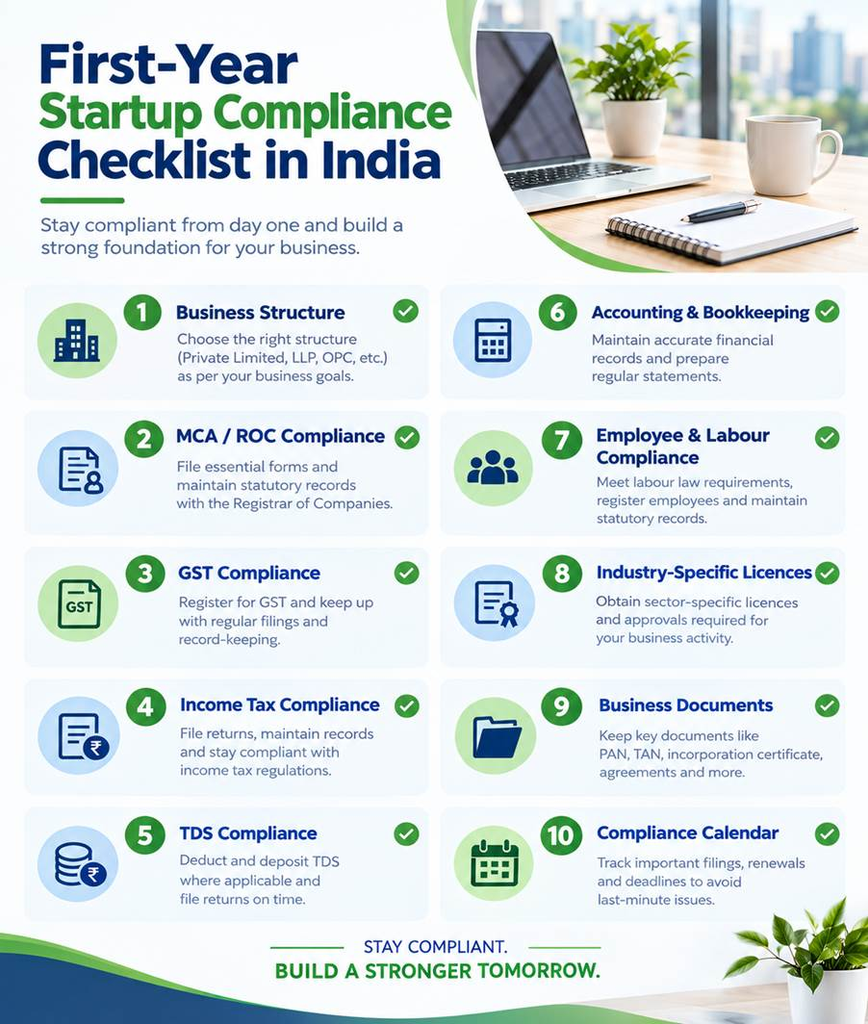
Before completing your first financial year, review the following:
First-Year Startup Compliance Checklist
☐ Business structure confirmed
☐ Post-incorporation requirements reviewed
☐ MCA/ROC requirements identified
☐ GST applicability checked
☐ GST records maintained, where applicable
☐ Books of accounts maintained
☐ Income tax requirements reviewed
☐ TDS applicability checked
☐ Employee/labour requirements reviewed
☐ Industry-specific licences identified
☐ Business documents organised
☐ Compliance calendar prepared
☐ Annual filing requirements reviewed
This checklist is a starting point, not a substitute for a business-specific compliance assessment.
Frequently Asked Questions
What is the first compliance after starting a business in India?
There is no single compliance that applies to every business. The first requirement depends on the entity structure, business activity and applicable laws. A company, LLP, partnership, and proprietorship can have different requirements.
Is GST registration mandatory for every startup?
No. GST registration depends on applicable GST rules, including factors such as turnover and the nature of supplies. Certain situations can also trigger registration requirements irrespective of the basic turnover test. Startups should check their specific circumstances.
What is ROC compliance?
ROC compliance refers to applicable filings and statutory requirements associated with entities registered with the Registrar of Companies. Requirements vary according to the type of entity and circumstances.
Do startups need to maintain books of accounts?
Businesses should maintain appropriate financial and accounting records according to the laws applicable to their entity and activity. Proper bookkeeping also helps with tax filing and financial management.
Can a startup get DPIIT recognition?
Eligible entities can apply for DPIIT Startup Recognition if they meet the applicable criteria. The current Startup India portal provides the latest eligibility requirements and application information.
What happens if startup compliance is ignored?
The consequences depend on the specific compliance that has been missed. Depending on the law and filing involved, a business may face additional fees, interest, penalties or other regulatory consequences.
How can a startup manage compliance better?
A startup can maintain a compliance calendar, organise documents, keep accounting records updated and review requirements regularly. Professional assistance can also be useful when the compliance structure becomes more complex.
Final Thoughts
Starting a business is only the beginning. Building the right compliance system during the first year can help founders manage their legal, tax and financial responsibilities in a more organised way.
The most important point is that there is no one-size-fits-all startup compliance checklist. A Private Limited Company, LLP, partnership firm and proprietorship may have different requirements, while industry-specific businesses may need additional registrations and licences.
Instead of waiting for a deadline, founders should identify their applicable requirements early and maintain a simple compliance calendar throughout the year.
If you are unsure which registrations or compliance requirements apply to your business, getting professional guidance can help you identify the requirements relevant to your business structure and activities.
AccountsWaale can help businesses understand and manage various business registration, tax, licensing and compliance requirements.
Connect with AccountsWaale for professional business registration, tax, licensing, and compliance support.
🌐 https://accountswaale.com/
📞 +91 92114 47604