You choose a business idea, register the entity, create a website, find customers, and start generating revenue. But once the business is operational, there is another side that is often overlooked — business compliance.
Many business owners think compliance simply means filing an income tax return once a year. In reality, depending on the nature and structure of your business, compliance can involve taxation, GST, accounting records, annual filings, employee-related requirements, licences, registrations and other regulatory obligations.
Missing an important filing or renewal may result in additional costs, notices, penalties or unnecessary operational problems.
That is why having a business compliance checklist can help you stay organised throughout the year.
This guide explains the major areas of business compliance in India and what entrepreneurs should keep track of in 2026.
What Is Business Compliance
Business compliance means following the legal, tax, financial and regulatory requirements that apply to your business.
These requirements can vary depending on factors such as:
-
- Business structure
-
- Nature of business
-
- Turnover
-
- Number of employees
-
- Location
-
- Type of products or services
-
- GST applicability
-
- Industry-specific regulations
-
- Whether the business operates in India or internationally
For example, a private limited company may have corporate annual filing requirements, while a small business may primarily need to focus on GST, income tax and applicable licences.
Similarly, a food business may have additional requirements related to food safety, while a security agency may require specific regulatory approval.
There is no single compliance checklist that applies to every business.
The right approach is to first identify which compliances apply to your business and then create a system to track them.
Why Is Business Compliance Important?
Compliance is not just about avoiding penalties.
Good compliance management can also help a business maintain accurate records, build credibility and avoid last-minute stress.
1. Avoid penalties and late fees
Missing statutory deadlines can result in interest, late fees or penalties, depending on the applicable law and nature of the default.
2. Keep business records organised
Regular accounting and filing make it easier to understand your business’s financial position.
3. Build credibility
Banks, investors, customers and business partners may expect proper documentation and regulatory compliance before working with a business.
4. Reduce the risk of notices
Accurate and timely reporting can help reduce avoidable compliance issues.
5. Make business growth easier
When your registrations, accounts, tax records and documents are properly maintained, expanding the business becomes more manageable.
Let’s break the checklist into the major areas that business owners should review.
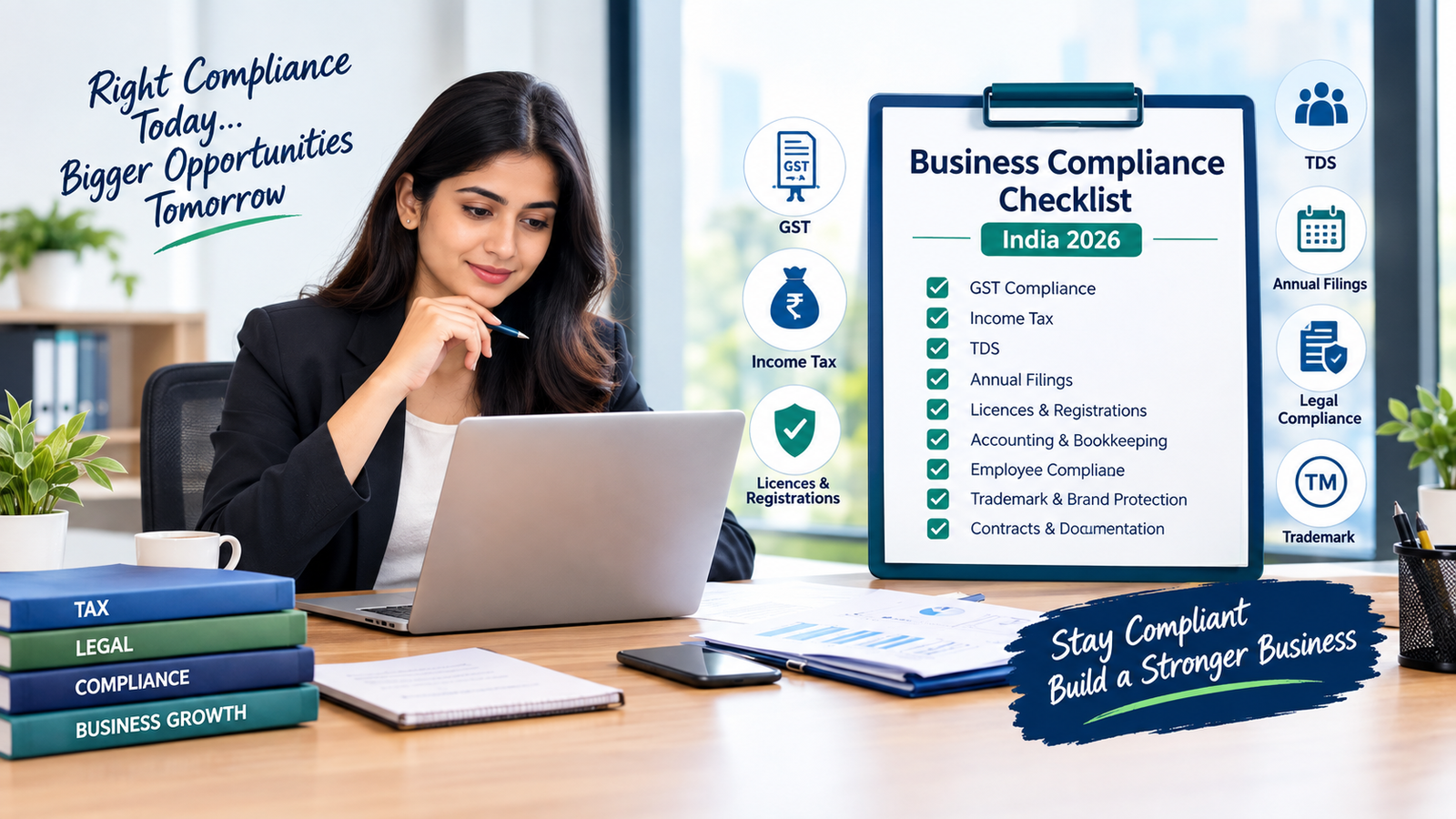
Business Compliance Checklist for 2026
Your first step is to make sure your business information is accurate and up to date.
1. Business Registration and Basic Details
Depending on your business structure, this may include:
-
- Private Limited Company
-
- Limited Liability Partnership (LLP)
-
- One Person Company (OPC)
-
- Partnership Firm
-
- Proprietorship
-
- Section 8 Company
-
- Trust or Society
Check whether your registered business details are still correct.
Review:
-
- Registered office address
-
- Business activity
-
- Directors or partners
-
- Contact information
-
- Bank details
-
- PAN and TAN details
-
- Registration certificates
-
- Other statutory registrations
If important information has changed, check whether the relevant authority needs to be notified.
2. GST Compliance
GST compliance is an important area for businesses registered under GST.
Depending on the taxpayer’s circumstances and filing frequency, GST compliance may involve returns such as GSTR-1 and GSTR-3B.
For example, the GST portal states that GSTR-1 is generally due on the 11th of the following month for monthly filers and the 13th of the month following the quarter for quarterly filers, subject to applicable rules or extensions.
Businesses should regularly check:
-
- Sales invoices
-
- Purchase invoices
-
- GST collected
-
- Input tax credit
-
- GST returns
-
- E-invoices, where applicable
-
- E-way bills, where applicable
-
- Customer GSTIN details
-
- GST payment records
One important habit is to reconcile your books with GST records regularly instead of waiting until the filing deadline.
3. Income Tax Compliance
Income tax compliance is another important part of running a business.
Depending on the business structure, you may need to maintain financial records, prepare financial statements and file the applicable income tax return.
For example, companies, LLPs, firms and individuals can have different tax and filing requirements.
Business owners should keep track of:
-
- Revenue
-
- Business expenses
-
- Bank transactions
-
- Invoices
-
- Fixed assets
-
- Loans
-
- Investments
-
- TDS
-
- Advance tax, where applicable
-
- Income tax return deadlines
The Income Tax Department currently provides tax calendars and filing information through its e-filing portal.
Also, remember that tax rules and filing deadlines can change. Therefore, businesses should check the latest official notifications rather than relying only on old compliance calendars.
4. TDS Compliance
If your business makes certain payments where tax deduction at source applies, TDS compliance becomes important.
TDS may apply to payments such as:
-
- Professional fees
-
- Rent
-
- Contractor payments
-
- Commission
-
- Salary
-
- Interest
-
- Certain other specified payments
The business may need to:
-
- Deduct the appropriate tax.
-
- Deposit the tax within the applicable deadline.
-
- File the relevant TDS statement.
-
- Issue the applicable TDS certificate.
The Income Tax Department states that TDS is generally deposited by the 7th of the following month, with specific rules and exceptions applying to certain situations.
For example, businesses deducting TDS on specified non-salary payments may have quarterly reporting obligations as well.
Compliance starts with good records.
5. Accounting and Bookkeeping
Even if your statutory filing is handled by a professional, your business should maintain organised financial information throughout the year.
Keep track of:
-
- Sales
-
- Purchases
-
- Expenses
-
- Bank transactions
-
- Receivables
-
- Payables
-
- Loans
-
- Assets
-
- GST records
-
- TDS records
-
- Payroll records
A simple monthly bookkeeping routine can prevent a major pile-up of work at the end of the financial year.
6. Annual Compliance for Companies and LLPs
If you operate through a company or LLP, additional annual compliance requirements may apply.
For companies, this can include maintaining statutory records, preparing financial statements and completing applicable annual filings.
LLPs also have their own filing and compliance requirements.
The exact requirements depend on the entity, financial year, applicability of audit and other factors.
Therefore, don’t treat company registration as the end of your compliance journey.
Registration is only the beginning.
Your business structure determines many of the ongoing responsibilities you need to monitor.
7. Licences and Registrations
Not every business needs the same licences.
This is one of the most common areas where entrepreneurs make mistakes.
The licences applicable to a business can depend on:
-
- Industry
-
- Products
-
- Services
-
- Location
-
- Business model
-
- Customers
-
- Import/export activities
-
- Number of employees
-
- Specific regulatory requirements
Depending on the business, requirements may include registrations or licences related to:
-
- FSSAI
-
- BIS
-
- PSARA
-
- Drug licence
-
- APEDA
-
- RNI
-
- GACC
-
- CDSCO
-
- WPC
-
- EPR
-
- Industry-specific approvals
For example, a food business may have FSSAI requirements, while a private security agency may require PSARA-related compliance.
The important point is simple:
Don’t apply for a licence just because another business has it. First check whether it actually applies to your business.
8. Trademark and Brand Protection
Legal compliance is not limited to taxes and government filings.
Your brand also deserves attention.
If your business operates under a particular brand name, consider whether the name and associated intellectual property should be protected.
Before investing heavily in:
-
- Logo design
-
- Packaging
-
- Website
-
- Advertising
-
- Social media
-
- Product labels
it is sensible to check the availability and protection requirements for your brand.
A business can spend years building recognition around a name. Protecting the brand early can help reduce avoidable disputes later.
9. Employee and Payroll Compliance
If you have employees, your compliance responsibilities may expand.
Depending on the size, location and nature of your organisation, you may need to consider requirements relating to:
-
- Payroll
-
- TDS on salary
-
- Employee records
-
- Employment documentation
-
- Provident Fund
-
- ESI
-
- Professional Tax, where applicable
-
- Shops and Establishments requirements
-
- Leave and wage-related requirements
-
- Other applicable labour regulations
The exact requirements should be evaluated according to your workforce and location.
10. Contracts and Business Documents
A business may be legally registered and tax compliant but still have weak documentation.
Review whether your business has appropriate agreements for:
-
- Customers
-
- Vendors
-
- Employees
-
- Freelancers
-
- Consultants
-
- Business partners
-
- Distributors
-
- Service providers
Important documents may also include:
-
- Terms and conditions
-
- Privacy policy
-
- Refund policy
-
- Service agreements
-
- Non-disclosure agreements
-
- Purchase agreements
Good documentation helps clarify responsibilities before a disagreement happens.
11. Keep a Compliance Calendar
One of the easiest ways to manage compliance is to create a simple compliance calendar.
Instead of remembering every deadline yourself, maintain a monthly tracker.
Your calendar can include:
| Compliance Area | Frequency | What to Track |
|---|---|---|
| GST | Monthly/Quarterly | Returns and tax payment |
| TDS | Monthly/Quarterly | Deposit and statements |
| Income Tax | Annual/Periodic | Returns and tax payments |
| Company Compliance | Periodic/Annual | Applicable MCA filings |
| LLP Compliance | Periodic/Annual | Applicable LLP filings |
| Licences | Periodic | Renewal and validity |
| Accounting | Monthly | Books and reconciliations |
| Payroll | Monthly | Salary and applicable deductions |
| Trademark | As applicable | Application/status/renewal |
The exact frequency depends on the business and applicable regulations.
Monthly Business Compliance Checklist
A practical monthly review can look like this:
Week 1
-
- Update sales and purchase records
-
- Reconcile bank transactions
-
- Collect missing invoices
-
- Review expenses
Week 2
-
- Check GST data
-
- Verify input tax credit
-
- Review customer and vendor GST details
-
- Check applicable GST filings
Week 3
-
- Review TDS requirements
-
- Process applicable deductions
-
- Check payroll records
-
- Review outstanding compliance tasks
Week 4
-
- Check upcoming deadlines
-
- Review licence expiry dates
-
- Update compliance tracker
-
- Keep documents ready for the next filing cycle
This small monthly routine can make annual compliance significantly easier.
Common Business Compliance Mistakes to Avoid
Mistake 1: Thinking registration means compliance is complete
Registering your company is only the starting point.
Once the business starts operating, ongoing tax, accounting and regulatory responsibilities may begin.
Mistake 2: Waiting until the deadline
Last-minute filing increases the possibility of missing documents, incorrect information and avoidable errors.
Mistake 3: Assuming every business needs the same licences
Licence requirements depend heavily on the business activity, location and other factors.
Mistake 4: Ignoring small changes
Changes in directors, partners, registered address, business activity or other important details may require updates.
Mistake 5: Mixing personal and business transactions
Keeping business and personal finances separate makes accounting, reporting and financial tracking much easier.
Mistake 6: Relying on an old compliance checklist
Tax and regulatory requirements can change.
For example, the Indian income-tax framework has undergone changes in 2026, so businesses should verify current requirements and applicable transition rules rather than blindly following an old checklist.
How to Build a Compliance System for Your Business
You don’t need a complicated system.
Start with five simple steps:
Step 1: Identify your business structure
Determine whether you operate as a proprietorship, partnership, LLP, company or another structure.
Step 2: List your registrations
Create a list of every registration, licence and certificate currently applicable to your business.
Step 3: Identify recurring compliances
Write down monthly, quarterly and annual requirements.
Step 4: Assign responsibility
Decide who is responsible for accounting, GST, TDS, annual filings, licence renewals and document management.
Step 5: Review regularly
Conduct a compliance review every month or quarter instead of waiting until the end of the year.
Final Thoughts
Business compliance may not be the most exciting part of entrepreneurship, but it is one of the foundations of a professionally managed business.
The goal isn’t simply to file everything on time.
The goal is to understand what applies to your business, maintain accurate records, track important deadlines and keep your registrations and documents up to date.
As your business grows, your compliance requirements may also change.
A business that starts with a simple structure may later add employees, cross state borders, register under GST, begin importing products, launch a new product category or enter a regulated industry.
That’s why compliance should be treated as an ongoing business process — not a once-a-year task.
Start with the basics. Track what applies. Review regularly. And get professional guidance when you’re unsure about a requirement.
If you are starting a business or need help understanding registrations, licences, tax-related compliance or ongoing business requirements, AccountsWaale can help you understand the applicable requirements and take the next step with greater clarity.
Ek Click, Legal Fix.
Frequently Asked Questions
What is a business compliance checklist?
A business compliance checklist is a list of legal, tax, accounting, regulatory and administrative requirements that a business needs to monitor based on its structure and activities.
Is business compliance the same for every business?
No. Compliance depends on factors such as business structure, turnover, industry, location, employees, GST applicability and specific business activities.
What are the most common business compliances in India?
Common areas include income tax, GST, TDS, accounting, annual filings, licence renewals, payroll-related requirements and industry-specific registrations.
How often should a business review its compliance?
A monthly review is a practical approach for most businesses. Some requirements may be monthly, quarterly or annual, so maintaining a compliance calendar is useful.
Can a startup ignore compliance during its early stage?
No. Even a newly started business should identify the legal and regulatory requirements applicable to its structure and activities from the beginning.
Does every business need GST registration?
No. GST registration depends on factors such as turnover, nature of supplies, location and other applicable provisions. Businesses should determine GST applicability based on their specific circumstances.
Disclaimer
This article is intended for general informational purposes only. Business, tax and regulatory requirements may vary depending on individual circumstances and may change through amendments, notifications or government updates. Always verify the current requirements applicable to your business before taking action.
Need help with your business compliance?
AccountsWaale helps businesses with registrations, licences, certifications and compliance support.
Ek Click, Legal Fix.
— AccountsWaale Team