

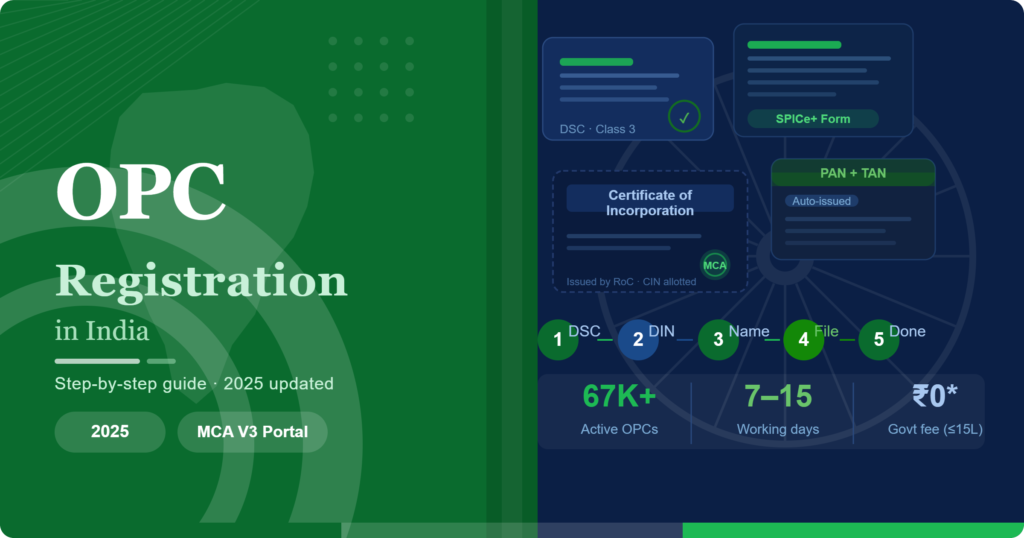
India’s surge in solo entrepreneurship over the past decade centers on the OPC registration structure. By April 2025, over 67,000 active OPCs are registered, with more than 1,500 new incorporations monthly. For solo founders, freelancers, or consultants, completing your OPC registration offers limited liability and corporate credibility.
This guide covers everything you need to know about OPC registration, highlighting the latest 2025 MCA updates.
What Is a One Person Company Under the Companies Act, 2013?
The concept of a One Person Company under the Companies Act, 2013, was introduced to bridge the gap between an informal sole proprietorship and a full-fledged private limited company. Defined under Section 2(62) of the Act, an OPC is a private company with just one member, one director, and a mandatory nominee. The two can be the same person.
Before 2013, starting a company required at least two directors and two members. The OPC registration framework changed that, giving individual entrepreneurs access to:
- Limited liability — your personal assets are protected from business losses.
- Separate legal identity — the company is a distinct entity from its owner.
- Perpetual succession — the business continues even in the event of the owner’s death or incapacity.
- Corporate credibility — banks, clients, and investors treat incorporated entities more seriously than proprietorships.
An OPC’s name must always end with (OPC) Private Limited, distinguishing it from other company types.
Eligibility: Who Can Apply for OPC Registration?
Eligibility: Who Can Apply for OPC Registration?
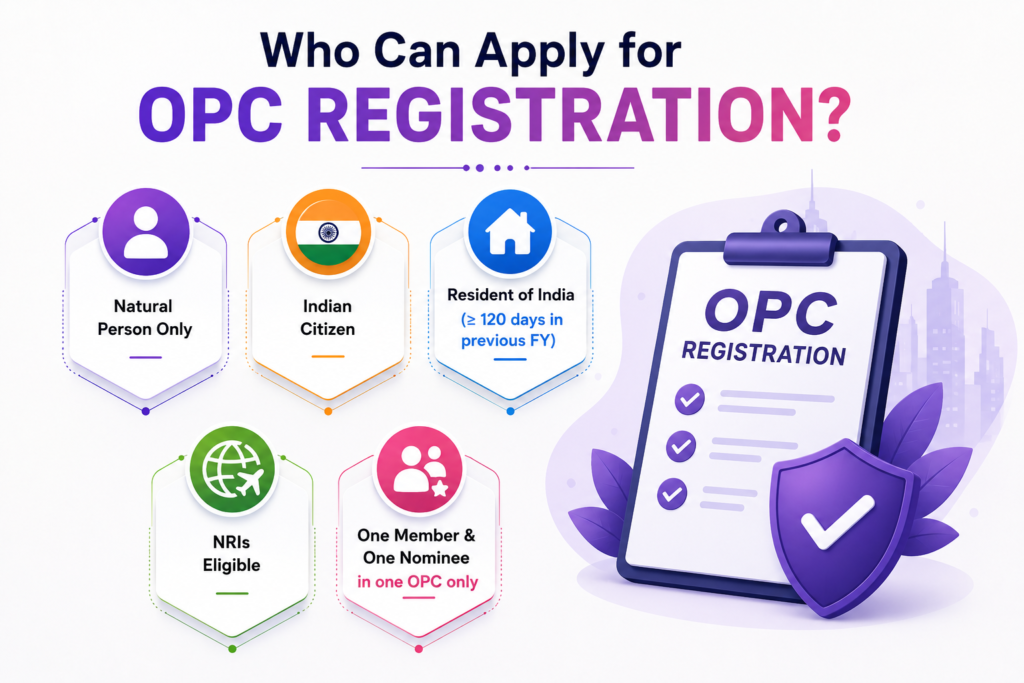
Ensure you meet these eligibility conditions before initiating OPC registration:
- You must be a natural person — a company or LLP cannot form an OPC
- You must be an Indian citizen
- You must be a resident of India, meaning you have stayed in India for at least 120 days during the previous financial year (reduced from 182 days by the 2021 MCA amendment)
- Non-Resident Indians (NRIs) are now also eligible for OPC registration in India, a right granted effective April 1, 2021
- You can be a member and nominee in only one OPC at a time
OPC Registration Documents
Have the following documents ready before you begin to save time.
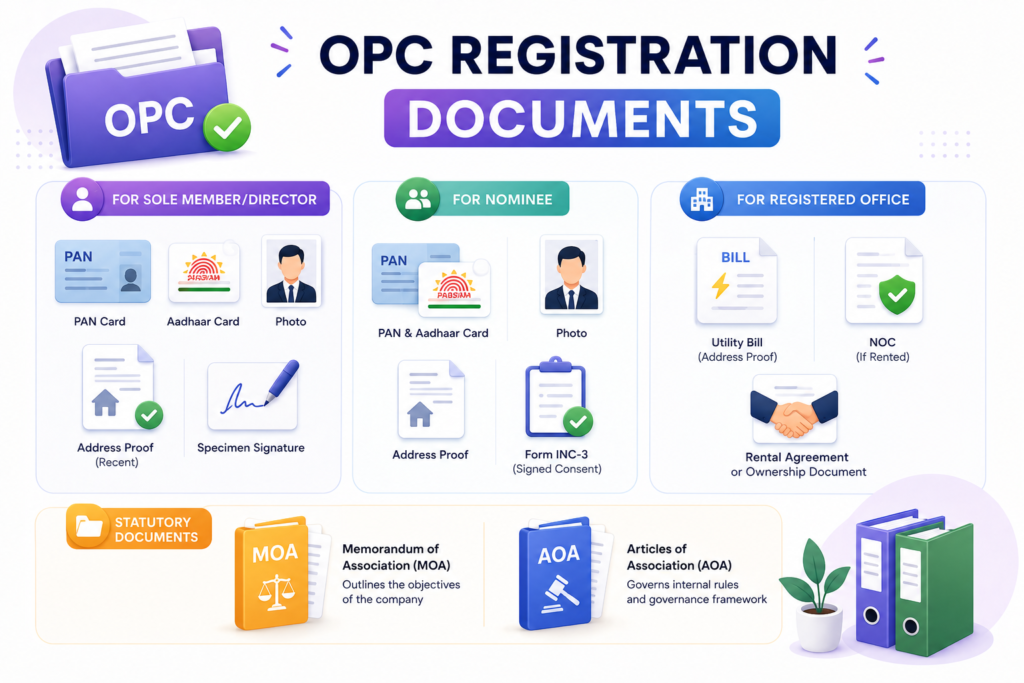
For the Sole Member/Director:
- PAN Card (mandatory)
- Aadhaar Card
- Passport-size photograph
- Address proof — bank statement or utility bill (not older than 2 months)
- Specimen signature
| For the Nominee: | For the Registered Office: | Statutory Documents: |
| PAN Card (mandatory) Aadhaar Card Passport-size photograph Address proof — bank statement or utility bill (not older than 2 months) Specimen signature | Utility bill (electricity, water, or gas) as address proof No Objection Certificate (NOC) from the property owner (if rented premises) Rental agreement or ownership document | Memorandum of Association (MOA) — outlines the objectives of the company Articles of Association (AOA) — governs internal rules and governance framework |
MCA OPC Registration: The Role of SPICe+ and MCA V3
The MCA OPC registration process is handled entirely through the Ministry of Corporate Affairs (MCA) portal via the integrated SPICe+ form (Simplified Proforma for Incorporating Company Electronically Plus). As of July 2025, all company registrations must be filed through the MCA V3 portal, which has replaced the older PDF-based system entirely.
The V3 portal provides real-time data validation — forms are filled out directly in the browser and cross-checked against PAN, Aadhaar, and DIN databases instantly. An AI-powered system flags inconsistencies, such as address mismatches or name similarities, before submission, dramatically reducing the risk of rejection.
OPC Registration Process: Step by Step
Here is the complete OPC registration process, updated for 2025:
Step 1 — Obtain a Digital Signature Certificate (DSC) Visit the website of a government-recognized certifying authority. Choose the Class 3 DSC option, which is mandatory for the proposed director. Submit the required documents and, after approval, download your DSC. This process typically takes 1–2 working days.
Step 2 — Apply for Director Identification Number (DIN) During incorporation, the proposed director is automatically allotted a unique DIN when filing the SPICe+ form. There is no need for a separate DIN application at this stage.
Step 3 — Reserve the Company Name Submit your preferred company names using Part A of the SPICe+ form or the RUN service on the MCA portal. You can propose up to two names. Ensure the proposed name ends with “(OPC) Private Limited” and does not conflict with any existing names or trademarks. Once approved, the name reservation is valid for 20 days.
Step 4 — Draft MOA and AOA Prepare the Electronic Memorandum of Association (E-MOA) and Electronic Articles of Association (E-AOA), ensuring they comply with the Companies Act, 2013. Attach these documents to your SPICe+ filing.
Step 5 — File SPICe+ Form (Part B) Complete and submit Part B of the SPICe+ form via the MCA portal. Attach the MOA, AOA, nominee consent (Form INC-3), director consent (Form DIR-2), and registered office proof. A CA, CS, or CMA must certify the application before submission.
Step 6 — PAN and TAN Allotment After submitting the SPICe+ form, PAN and TAN are automatically generated during the incorporation process. You do not need to file separate applications for these.
Step 7 — Certificate of Incorporation After verification, the Registrar of Companies (RoC) — processed centrally through the Central Registration Center (CRC) — issues the Certificate of Incorporation along with the CIN (Corporate Identification Number). This officially establishes your OPC.
The entire OPC registration process typically takes 7 to 15 working days, depending on document readiness and MCA processing time.
Important 2025 Update: Effective July 14, 2025, filing Form ADT-1 (appointment of statutory auditor) is now strictly mandatory within 30 days of incorporation. Missing the filing deadline attracts daily multiplying penalties.
OPC Registration Govt Fees
One of the most attractive aspects of OPC registration is the cost structure set by the government:
| Component | Fee |
| Government incorporation fee (capital up to ₹15 lakh) | ₹1,000 – ₹2,000 (varies by state) |
| Name reservation via RUN | ₹1,000 per application |
| DSC (Class 3) | ₹1,000 – ₹2,000 |
| Professional fees (CA/CS) | ₹3,000 – ₹8,000 |
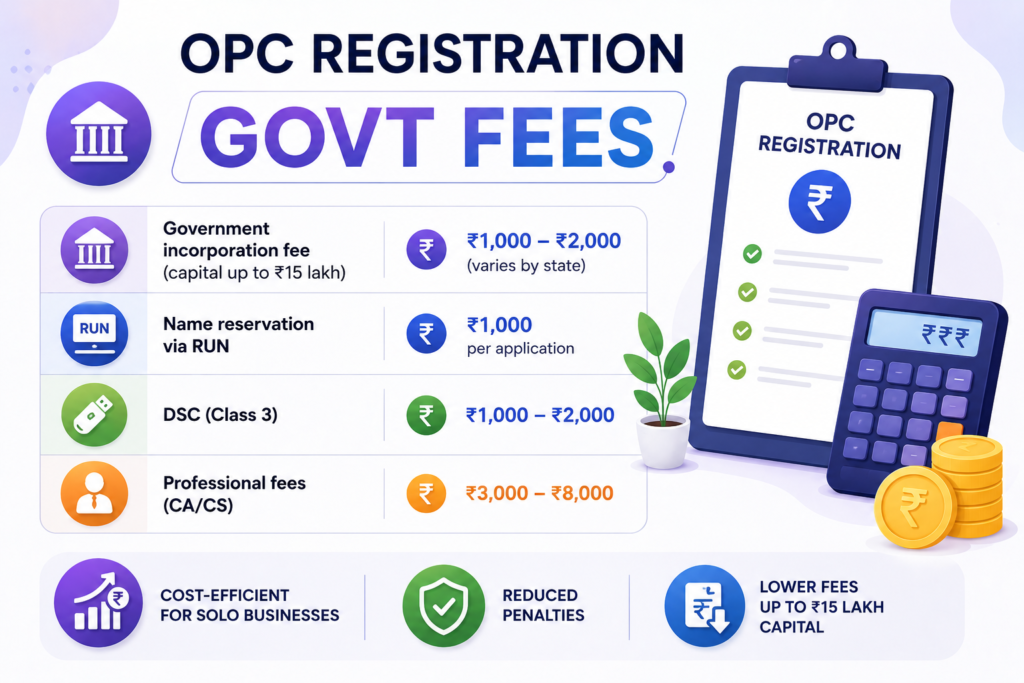
The government fees for OPC registration andincorporation have been reduced for capital up to ₹15 lakh, making it one of the most cost-efficient ways to formalize a solo business in India. For capital beyond ₹15 lakh, government fees scale based on the authorized capital slab. Additionally, OPCs benefit from significantly reduced penalties under Section 446B of the Companies Act — a maximum fine of ₹5,000 plus ₹500 per day for continuing contraventions.
OPC Turnover Limit Amendment: The Game-Changer of 2021
Perhaps the single most impactful regulatory change for OPC owners came through the Companies (Incorporation) Second Amendment Rules, 2021, effective April 1, 2021.
Prior to this amendment, an OPC was mandatorily required to convert into a private or public limited company if its paid-up capital exceeded ₹50 lakh, or its average annual turnover exceeded ₹2 crore over three consecutive financial years. This was a significant constraint — founders had to carefully monitor their revenue to avoid triggering a compliance-heavy restructuring.
The 2021 amendment completely removed these mandatory conversion thresholds. Key changes include:
- An OPC can now grow its turnover and paid-up capital without any upper limit and continue operating indefinitely
- The 2-year lock-in period for voluntary conversion was abolished — an OPC can now convert into a private or public company at any time
- NRIs became eligible for OPC registration in India
- The residency threshold was reduced from 182 days to 120 days
This was a landmark shift in policy. The intent was to allow OPCs to grow without restrictions, directly benefiting startups, e-commerce sellers, and small innovators. Voluntary conversion remains available for founders who wish to add members, raise external investment, or scale operations — but it is no longer forced by financial thresholds.
Post-Registration Compliance Essentials
Completing your OPC registration is the beginning, not the end. Key annual compliances include:
- AOC-4 — Filing of financial statements within 180 days from the close of the financial year
- MGT-7A — Simplified annual return within 60 days of the deemed AGM date (OPCs are exempt from holding AGMs)
- ITR-6 — Income tax return (OPCs are taxed at the corporate rate of 25% for turnover up to ₹400 crore, or 22% under Section 115BAA)
- DIR-3 KYC — Annual KYC for every director, due by September 30 each year
- Statutory Audit — Mandatory every financial year
OPCs are exempt from preparing a cash flow statement and do not require a company secretary to sign books of accounts — perks that meaningfully reduce the compliance burden compared to a private limited company.
Final Thoughts
The OPC registration structure has matured significantly since its introduction in 2013. With the 2021 amendments removing turnover and capital ceilings, the MCA V3 portal streamlining filings, and government incorporation fees reduced for standard capital levels, there has never been a better time to formalize your solo venture. Whether you are a freelance designer, IT consultant, or first-time startup founder, OPC registration gives you the legal foundation to operate with credibility, protect your personal assets, and scale on your own terms.
If all documents are in order, your OPC registration can be completed in under two weeks — and your business journey can begin with the confidence of a registered company behind it.