

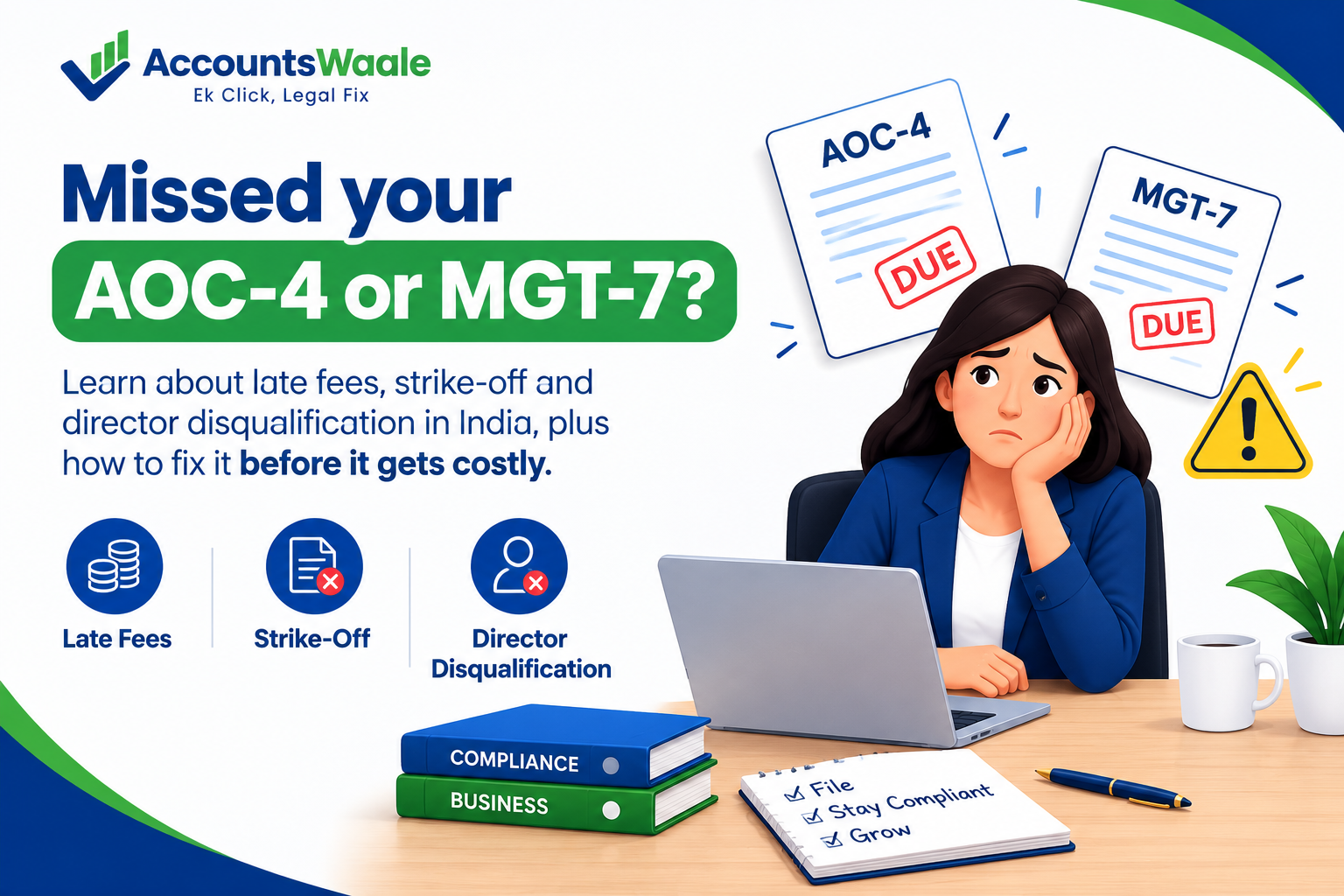
 Picture a founder in Noida. Let’s call him Rohit. He started a small Pvt Ltd company two years ago. Sales were picking up, the team was growing, and filing paperwork with the Registrar of Companies was always “next week’s problem.”
Then one morning he got an email with a notice from the MCA. His heart sank.
If you’ve ever felt that sinking feeling about a compliance deadline, you’re not alone. Missed ROC filings are one of the most common problems for Indian startups and small businesses. The good news is that most of it is fixable, especially if you act early. Let’s go through it in plain language.
What is ROC annual filing?
Every company registered in India must file certain documents with the Registrar of Companies every year, whether it earned a rupee or not. For a private limited company, the two big ones are:
-
- AOC-4, your financial statements (balance sheet and profit & loss)
-
- MGT-7 / MGT-7A, your annual return, which records shareholders, directors and key company details
Both depend on your AGM (Annual General Meeting) date. Generally, AOC-4 is due within 30 days of the AGM and MGT-7 within 60 days of it. Since most companies hold their AGM by 30 September, October and November become the busiest months of the compliance year.
If you run an LLP, your filings are different. You file Form 11 (annual return) and Form 8 (statement of accounts and solvency). Form 8 is generally due by 30 October.
“Nil activity, so I don’t need to file.” Is that true?
This is the most expensive myth in Indian compliance. A company with zero sales still has to file. Zero turnover does not mean zero compliance.
What happens if you miss the deadline?
Here’s the realistic picture:
-
- Late fees: For most ROC forms, the additional fee is ₹100 per day of delay. There is usually no upper limit, so a delay of a few months can cost more than the filing itself. LLP late fees also run at ₹100 per day.
-
- Penalties on the company and directors: Defaults can attract adjudication and monetary penalties under the Companies Act.
-
- Strike-off risk: If the ROC believes a company is not carrying on business or not filing returns, it can start the process of striking the company’s name off the register.
-
- Director disqualification: This one hurts the most. If a company fails to file financial statements or annual returns for three continuous financial years, its directors can be disqualified for five years. During that time, they cannot be appointed as a director in any company, not only the defaulting one.
Imagine losing the right to sit on the board of your own company because of a form that took two hours to file.
Why is this suddenly in the news?
Two reasons.
First, the MCA recently ran a one-time compliance relief scheme for companies with pending filings. Many businesses used it, but many others missed it. With the scheme over, the regular late fees apply again.
Second, there has been plenty of talk about MCA portal slowdowns around peak filing time. Industry bodies have asked for extensions, but extensions are never guaranteed. Planning as if there won’t be one is the smarter move.
A simple 5-step recovery plan if you’ve already missed a deadline
Step 1: Don’t panic, and don’t ignore it. The fee grows daily, so every week of delay makes it worse.
Step 2: Check your company’s status. Log in to the MCA portal and look at your company’s master data. Is it “Active”, or does it show “Active – Non-Compliant” or a strike-off flag?
Step 3: Collect your documents. You’ll need the audited financials, the director’s report, AGM notice and minutes, and DSC (digital signature) details for the signing directors.
Step 4: Reply to any notice on time. Notices usually come with a response window. Missing it can turn a small default into a bigger penalty.
Step 5: File the pending returns, oldest year first. If you’ve missed multiple years, clear them in order and make sure the numbers match your tax and GST records.
Mistakes that cost founders money
-
- Treating the AGM date casually. Every downstream deadline is calculated from it.
-
- Mismatched numbers. The turnover in your ROC filing should be consistent with your GST returns and ITR. Differences invite questions.
-
- Changing your registered address and not updating it. Notices go to the old address, and you find out too late.
-
- Leaving director KYC (DIR-3 KYC) pending. A director’s DIN can get deactivated for this alone.
-
- Depending on one person who “knows everything.” If that person leaves, so does your compliance memory.
A quick compliance calendar you can keep on your phone
| What | Who | Typical timing |
|---|---|---|
| Auditor appointment (ADT-1) | Companies | Within 15 days of the AGM |
| AOC-4 | Companies | Within 30 days of the AGM |
| MGT-7 / 7A | Companies | Within 60 days of the AGM |
| Form 8 | LLPs | 30 October |
| Form 11 | LLPs | 30 May |
| DIR-3 KYC | Every DIN holder | 30 September every year |
| ITR | Company / LLP | Check the current year’s due date |
Dates can change through circulars, so always verify on the official MCA portal before filing.
Prevention beats cure: build a small compliance habit
You don’t need to become a compliance expert. You just need a system:
-
- Block the dates on your calendar a month in advance.
-
- Keep your books updated monthly, not just at year-end.
-
- Store board minutes, resolutions and AGM records in one shared folder.
-
- Review your compliance status every quarter, the way you review sales.
-
- Work with a professional who explains things in simple language, not only legal jargon.
A founder’s job is to build the business. Compliance should run quietly in the background, like your electricity bill that gets paid on time without drama.
Final thoughts
Rohit did sort things out in the end. He filed the pending returns, paid the late fees, and set up a calendar so it wouldn’t happen again. He told us afterwards that the worst part was the fear of the unknown, not the work itself.
If you’re in the same situation, remember this: most compliance problems are far cheaper and simpler to solve when you act now rather than later.
If you’d like a second pair of eyes on your company’s status, whether for annual filings, GST return filing or ITR filing, the team at AccountsWaale is happy to talk it through. Starting something new instead? Our guides on Private Limited and LLP registration are a good place to begin.